

Human decision-making often happens faster than people realize. Research from Harvard University and cognitive science studies on rapid judgment suggest that people frequently form impressions and make choices within seconds, especially when situations involve uncertainty and immediate feedback. Digital systems increasingly reflect this pattern by creating environments where decisions happen quickly and outcomes appear almost instantly.
As digital wagering and prediction environments have evolved, systems built around fast choices have become more visible across many formats. Some platforms use simple mechanics based on immediate outcomes, while others involve prediction elements connected to larger events or communities. Discussions surrounding systems where users play coinflip on MM2bet as an example of fast outcome mechanics illustrate how simple binary choices have become a point of reference in broader conversations about digital interaction design. The focus extends beyond individual platforms and instead raises larger questions about why immediate decision structures continue attracting user attention.
How Quick-Decision Systems Developed Over Time
Early forms of wagering and prediction activities often depended on simple structures. A coin toss represented one of the most direct examples. Two possibilities existed, uncertainty remained clear, and the result appeared immediately. Similar ideas eventually appeared in many forms of entertainment and prediction environments.
Over time, digital platforms expanded these structures. Systems became visually dynamic, response times shortened, and users could interact continuously. Rather than waiting for long event cycles, people increasingly encountered experiences designed around rapid actions and rapid feedback.
McKinsey & Company has discussed how modern digital products often reduce friction points between action and response because users generally react positively to systems that feel immediate and seamless. This principle extends far beyond gaming or wagering. Streaming platforms, social applications, and digital marketplaces use similar engagement structures.
Fast decisions therefore became less about the individual activity itself and more about the underlying design pattern. Immediate interaction creates a sense of movement and continuation that many users naturally respond to.
Comparing Sports Prediction Behavior and Coinflip Mechanics
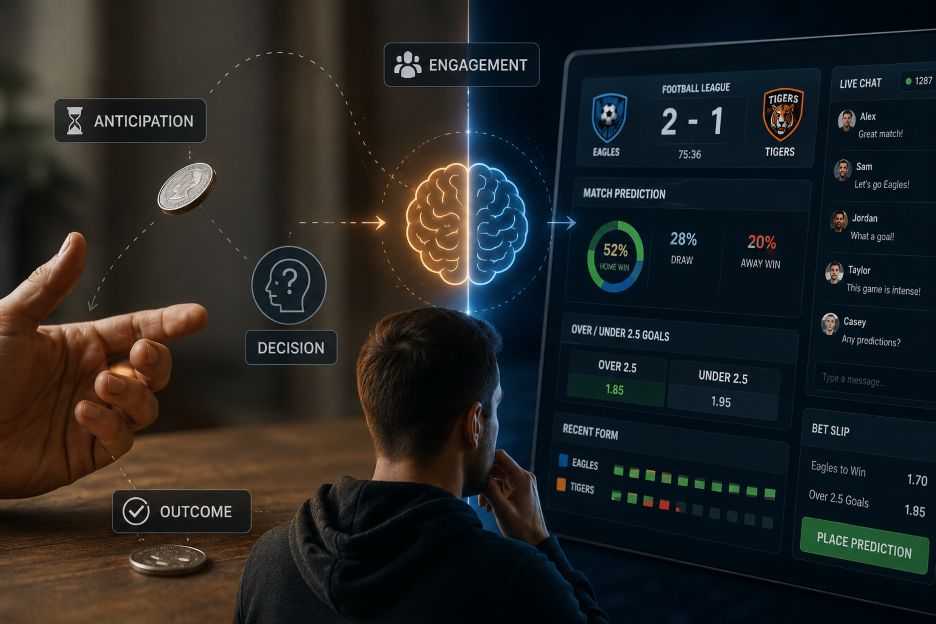
At first glance, sports prediction systems and coinflip-style mechanics appear very different. Sports involve teams, statistics, player conditions, and changing circumstances. Coinflip environments often revolve around a simpler structure with two immediate possibilities.
Despite these differences, both systems share several psychological characteristics.
- Both involve anticipation before an outcome appears.
- Both create emotional responses linked to uncertainty.
- Both require a choice before complete information becomes available.
- Both create periods of tension followed by resolution.
Research from The American Psychological Association has noted that uncertain situations can activate heightened attention and emotional investment because the human brain naturally seeks closure and resolution. This tendency explains why people often remain engaged even during short events.
Sports predictions may involve extended timelines where users wait through an entire game or competition. Quick-decision mechanics compress the same emotional cycle into much shorter periods.
The overall process remains surprisingly similar. An individual encounters uncertainty, makes a choice, anticipates an outcome, and then experiences immediate resolution.
Skill Perception Versus Randomness
A debate often emerges when comparing prediction systems and rapid-outcome mechanics. People frequently interpret some activities as skill-driven while viewing others as purely chance-based.
Sports environments encourage users to examine information before making judgments. Team performance, injuries, weather conditions, and historical trends may contribute to perceived knowledge. Participants can feel a greater sense of control because they believe decisions are informed by available data.
Quick-outcome mechanics function differently. Binary systems often make uncertainty more visible because fewer variables appear present. Outcomes feel direct and simplified.
However, human perception does not always separate these experiences as clearly as expected.
Stanford University behavioral research has shown that individuals frequently detect patterns even within random systems. People naturally search for explanations and meaning, even when outcomes occur independently.
This creates an interesting contrast. Users may feel stronger control in environments with visible information even though unpredictability still exists. Meanwhile, systems with obvious randomness can remove some of that perception of control while maintaining similar emotional responses.
The distinction between skill and chance therefore becomes partly psychological. User experience is influenced not only by actual mechanics but also by how participants interpret those mechanics.
What Fast Mechanics Reveal About User Engagement
Rapid decision systems reveal broader lessons about digital behavior. Immediate interactions fit naturally into modern online environments where attention shifts quickly between activities.
People increasingly consume short videos, instant notifications, and brief content interactions. Fast-response systems align with these patterns because they create short cycles of action and feedback.
Digital researchers from Nielsen Norman Group have observed that users often favor interfaces that minimize delays and maintain continuous interaction flow. Extended waiting periods can interrupt attention and reduce involvement.
Some observers therefore argue that rapid systems simply reflect changing digital habits rather than creating entirely new behaviors. Discussions around broader discussions around how betting environments influence user decision-making also highlight how user behavior can be shaped by presentation, timing, and perception rather than by outcomes alone. These observations suggest that interface design and response speed may play a larger role in engagement patterns than many users initially recognize.
Others raise concerns that speed itself can influence decision patterns. When choices happen repeatedly with limited pauses between actions, individuals may have less time for reflection.
This discussion becomes increasingly relevant as digital environments continue evolving. Engagement systems designed around immediate feedback can hold attention effectively, but they also raise questions regarding pacing and user awareness.
Balancing Engagement With Awareness
Fast-decision systems continue appearing across many digital spaces because they align closely with natural patterns of anticipation and response. Whether examining sports prediction behavior or rapid outcome environments such as digital coin toss mechanics, similar emotional structures repeatedly emerge.
Even experiences involving digital flip-style interactions or instant prediction mechanics share common elements with larger competitive systems. The attraction often comes from uncertainty itself rather than from complexity alone.
At the same time, speed can affect how people process choices. Responsible engagement remains important because rapid cycles may encourage repeated interaction without extended reflection. Individuals participating in gambling-related environments should remain aware of potential risks and maintain boundaries that support informed decision-making and balanced use.
Understanding why people respond to these systems ultimately reveals something broader about human behavior. People are naturally drawn toward moments of uncertainty followed by resolution. Digital environments simply deliver that experience in increasingly faster forms.